The smaller the earring, the less there is to hide behind. A tiny diamond bar, square stud or polished gold disc may look simple, but simplicity makes proportion, setting, polish and fit more exposed — not less important. In small fine jewellery, a fraction of a millimetre can change whether a stud looks crisp and intentional or slightly off.

What makes a small diamond earring well made?
Look at the geometry of the front, how straight the post is, how evenly the stone is set, whether the gold feels properly proportioned rather than flimsy, how cleanly the surfaces are polished and whether the fastening allows the earring to sit correctly on the ear. A small earring should look simple because it is precise — not because there is very little to it.
A plain shape has nowhere to hide an awkward line
In a highly decorative piece, the eye has many things to look at. In a small minimalist earring, the shape itself becomes the design.
A round disc should read as clean and balanced. A bar should feel straight and deliberate. A square stone should sit square. If the geometry is slightly off, the simplicity makes it easier to see.
This is why small jewellery can require just as much discipline in proportion as a much larger piece.


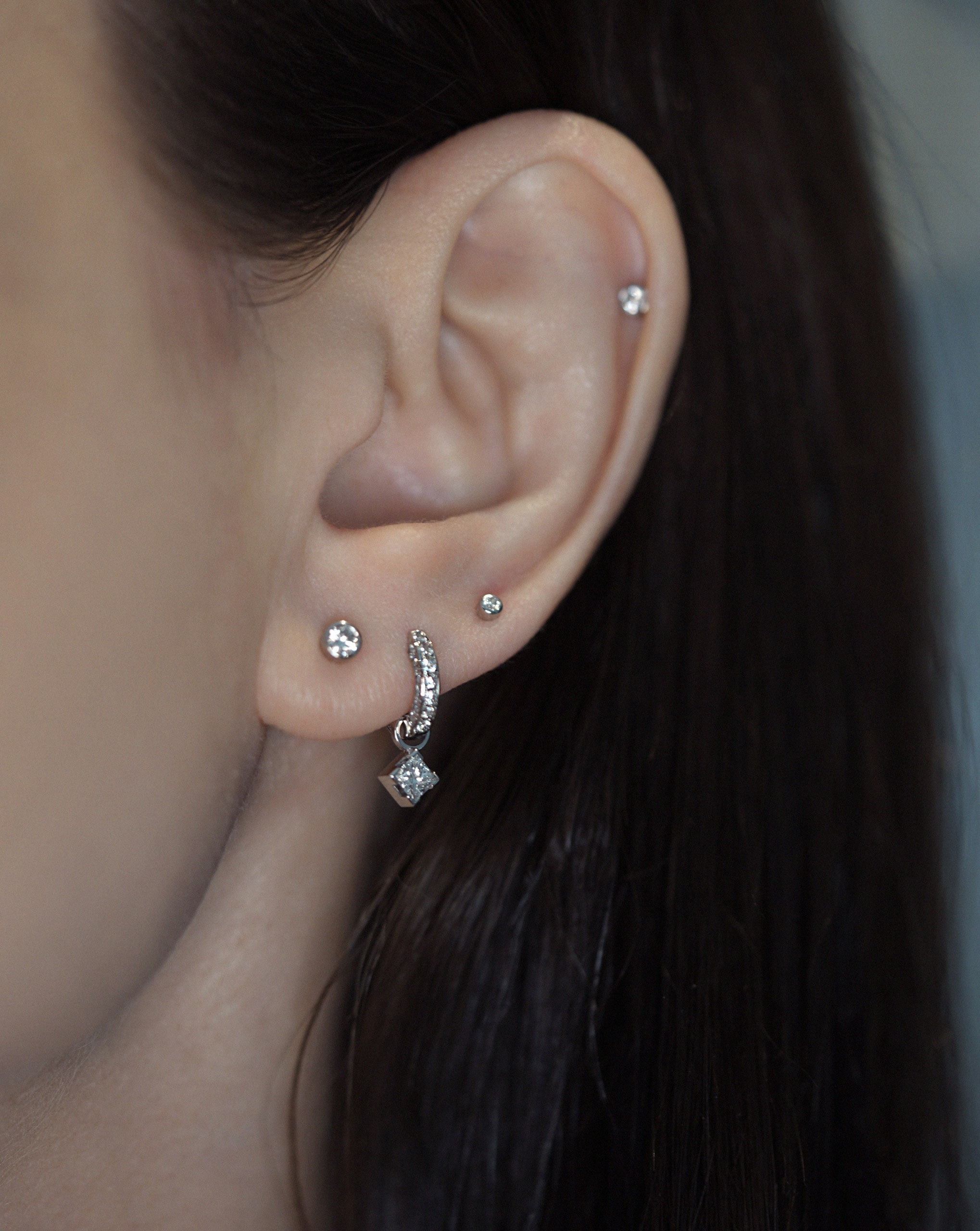
A small diamond still needs to sit exactly where it belongs
A diamond does not become easier to set simply because it is small. In fact, a tiny stone inside a very clean design can make imprecision more obvious.
Look for a stone that sits level, a setting that is visually balanced around it and no obvious excess metal overwhelming the diamond.
The aim is security without making the setting itself look heavy.
Diamond Bar Stud
The
Diamond Bar Stud
combines a straight linear form with natural diamonds in solid 18ct gold.
Because the eye follows the line of the bar, alignment matters. A long narrow piece exaggerates even a small visual tilt more than a round stud would.
This is the kind of design where clean proportion and post alignment are part of the finished appearance, not invisible technical details.

A square diamond cannot pretend to be straight if it is not
Round stones are naturally forgiving to the eye because they do not have a visible top, bottom or corner orientation.
Princess, emerald, baguette and other geometric cuts behave differently. Their edges create obvious reference lines, so the setting needs to respect the geometry of the stone.
That is one reason a very small geometric diamond stud can feel more architectural than a conventional round solitaire.
Princess Cut Diamond Piercing Stud
The
Princess Cut Diamond Piercing Stud
uses a natural square diamond in solid 18ct yellow or white gold.
The square outline gives the eye four clear edges to read. That makes stone orientation, setting symmetry and the way the front sits on the ear particularly important.
Selected Lena Cohen studs also allow the bar length to be customised where a different fit is required.

Visual delicacy and structural weakness are not the same thing
Fine jewellery can look very light without being reduced to the thinnest possible amount of metal.
The gold still has to support the stone, hold the setting securely, connect properly to the post and withstand normal handling.
When comparing very small earrings, ask whether the piece looks refined because its proportions are controlled or merely fragile because material has been removed.

Match Stick Earrings
The
Match Stick Earrings
use a narrow solid 18ct gold form with one bezel-set natural diamond.
The design is visually light, but the long line still needs enough structural integrity to remain straight and enough gold around the diamond to hold the setting properly.
This is a useful example of the difference between fine proportion and simply making something thin.

Three tiny diamonds can be harder to balance than one
Once several small stones share a tiny surface, consistency becomes part of the design.
Spacing, stone size, orientation and the amount of metal between each diamond all affect whether the finished front looks deliberate or crowded.
A small multi-stone stud should read as one coherent form rather than several stones competing for space.
Troika Diamond Stud
The
Troika Diamond Stud
sets three round brilliant-cut natural diamonds into a compact triangular composition in solid 18ct gold.
The individual diamonds are small, but the quality of the finished piece depends on how evenly they sit together and whether the triangular outline remains visually balanced.
For clients who prefer a flat-back construction, there is also a
Troika Diamond Flat-Back Stud.


A beautiful front can still sit badly if the post does not work with the ear
Post alignment matters because it influences how the visible front sits once the earring is worn.
A post that is unnecessarily long can allow some studs to move or tilt. A post that is too short may feel restrictive. The correct length depends on the design and the individual ear.
Selected Lena Cohen screw-back studs allow the bar length to be adjusted where required.
For a deeper explanation of screw backs, flat backs and post fit, read our
guide to secure earring backs.

Quality does not stop where the photograph stops
Product photography naturally concentrates on the decorative front, but a small stud also includes the post, fastening, underside and connection between those elements.
Those areas should feel properly finished rather than treated as purely functional afterthoughts.
For an earring that may be handled regularly, the quality of those small components matters every time it is put on or removed.

A clean surface is part of the design language
On a small polished disc, bar or geometric stud, there may be very little texture to distract from the surface itself.
That means uneven finishing, rough transitions or poorly resolved edges can become disproportionately noticeable.
A high polish should support the shape rather than blur it. Corners should still look intentional, lines should remain clear and the finished object should feel resolved from every angle.

Scale changes the specification — not the need for sensible stone selection
Very small accent diamonds are not assessed in exactly the same way as a significant centre stone, but that does not mean selection becomes irrelevant.
Brightness, consistency and how the stone works with the setting still affect the finished appearance.
Lena Cohen diamond earrings use natural diamonds in solid 18ct gold. For significant bespoke stones, certification and documentation can form part of the commission where appropriate.

Two small earrings should look intentionally related
For a matching pair, the eye will naturally compare one side with the other.
Stone size, visible proportions, setting height and orientation should feel balanced as a pair, even though natural stones are never manufactured objects with mathematically identical internal characteristics.
If the earrings are intended to be worn asymmetrically or as singles, that requirement changes — which is why many Lena Cohen ear designs are available individually as well as in pairs.

“Gold” and “solid 18ct gold” are not the same description
A useful quality check starts with understanding what the earring is actually made from.
Lena Cohen fine earrings are made in solid 18ct gold rather than gold-plated base metal. Our diamond designs use natural diamonds.
If you want a broader explanation of jewellery descriptions, hallmarking and material terminology, continue to our
guide to reading fine jewellery claims.

Small does not mean the design has to be standard
A bespoke earring commission may be about scale rather than extravagance: a particular diamond cut, one significant single stud, a pair of different shapes, a specific setting height or proportions developed around the wearer.
We can also source natural diamonds around a defined brief and develop the setting around the stones rather than forcing the stones into an existing design.
Lena Cohen bespoke commissions generally begin from £3,000. Explore our
bespoke fine jewellery service
for individual earrings and larger natural-diamond projects.

Fine jewellery is still fine jewellery when the piece is tiny
Lena Cohen Jewellery is an independent, family-run London fine jewellery business working in solid 18ct gold, natural diamonds and selected natural gemstones.
Our jewellery is made in the UK through our London workshop and established British specialist jewellery trades where required.
Whether the finished piece is a tiny polished disc or a significant bespoke diamond stud, the standard of construction should not depend on how much visual space the jewellery occupies.
What to look for before you buy
Does a small diamond earring need good craftsmanship?
Yes. Small jewellery can make inaccuracies particularly visible because the design often depends on only one shape, one stone or one clean line.
What should I look for in a diamond stud setting?
Look for a stone that sits level, balanced metal around the diamond and a setting that feels secure without visually overwhelming the stone.
Is a very thin earring always more refined?
No. A well-proportioned fine earring still needs enough metal to support the stone, setting, post and normal wear. Delicacy and structural weakness are not the same thing.
Does post length affect how a stud looks?
It can. If a post is unnecessarily long, some fronts can move or tilt. Selected Lena Cohen studs can be made with a different bar length where the design allows.
Should a pair of diamond studs be perfectly identical?
Natural diamonds are not manufactured objects, but a well-matched pair should feel visually balanced in size, proportion, setting and overall appearance.
Are Lena Cohen diamond earrings made with natural diamonds?
Yes. Lena Cohen diamond earrings are made with natural diamonds and solid 18ct gold.
Can a small earring be made bespoke?
Yes. A bespoke commission can be developed around a particular natural diamond, cut, scale, setting, pair or single-earring brief.
Judge the small details precisely because the jewellery is small
A well-made small earring should not need excess decoration to prove its quality. The proportion should feel right, the diamond should sit properly, the gold should be finished cleanly and the fastening should allow the front to sit as intended.
That is what makes simplicity difficult to do well — and what makes a good small piece of fine jewellery worth looking at closely.