18ct Gold · Natural Diamonds · UK Fine Jewellery
A piercing stud may be only a few millimetres across, but that does not make it a simple piece of jewellery.
In a small earring, there is very little room to hide an uneven setting, an awkward post position, excess metal, poor finishing or a backing that does not suit the design. The front may be the part you notice first. The construction behind it determines how the piece actually works.
This is where fine piercing jewellery differs from simply making a fashion earring smaller: precious materials, stone setting, proportion, post and backing are considered as one object.

The Difference
Fine piercing jewellery has to work from both sides
The front carries the design: gold, diamond, gemstone, shape and scale. Behind the ear are the less visible decisions — the post, thread or press-fit connection, wearable length, backing and finishing. A successful small earring needs both.
01 · Small Scale, Little Room for Error
A few millimetres can expose the quality of the making
Large jewellery can use scale, surface and multiple elements to carry the design. A small piercing stud often has none of that distraction.
Look closely at whether the stone sits straight, whether the surrounding gold is even, whether the edges are properly finished and whether the post leaves the back of the earring in the right position.
On geometric designs, alignment becomes particularly obvious. With several stones, spacing and consistency matter. With one natural diamond, the relationship between the stone and the setting becomes most of the design.

02 · The Metal
“Gold jewellery” is not a complete specification
Solid 18ct gold contains 75% pure gold within the alloy. The word solid matters because the piece is made from that gold alloy throughout rather than carrying a thin gold-coloured surface layer.
Lena Cohen piercing jewellery is made in solid 18ct gold. Diamond jewellery uses natural diamonds rather than lab-grown diamonds, alongside selected natural gemstones and pearls across the wider ear collection.
For a broader explanation of how to read material claims, see
How to Read Fine Jewellery Claims.
03 · The Front
The setting should support the stone, not overwhelm it
In miniature jewellery, a fractionally heavier setting can change the whole piece. Too much surrounding metal can make a small diamond disappear. Too little structural metal may be an equally poor solution.
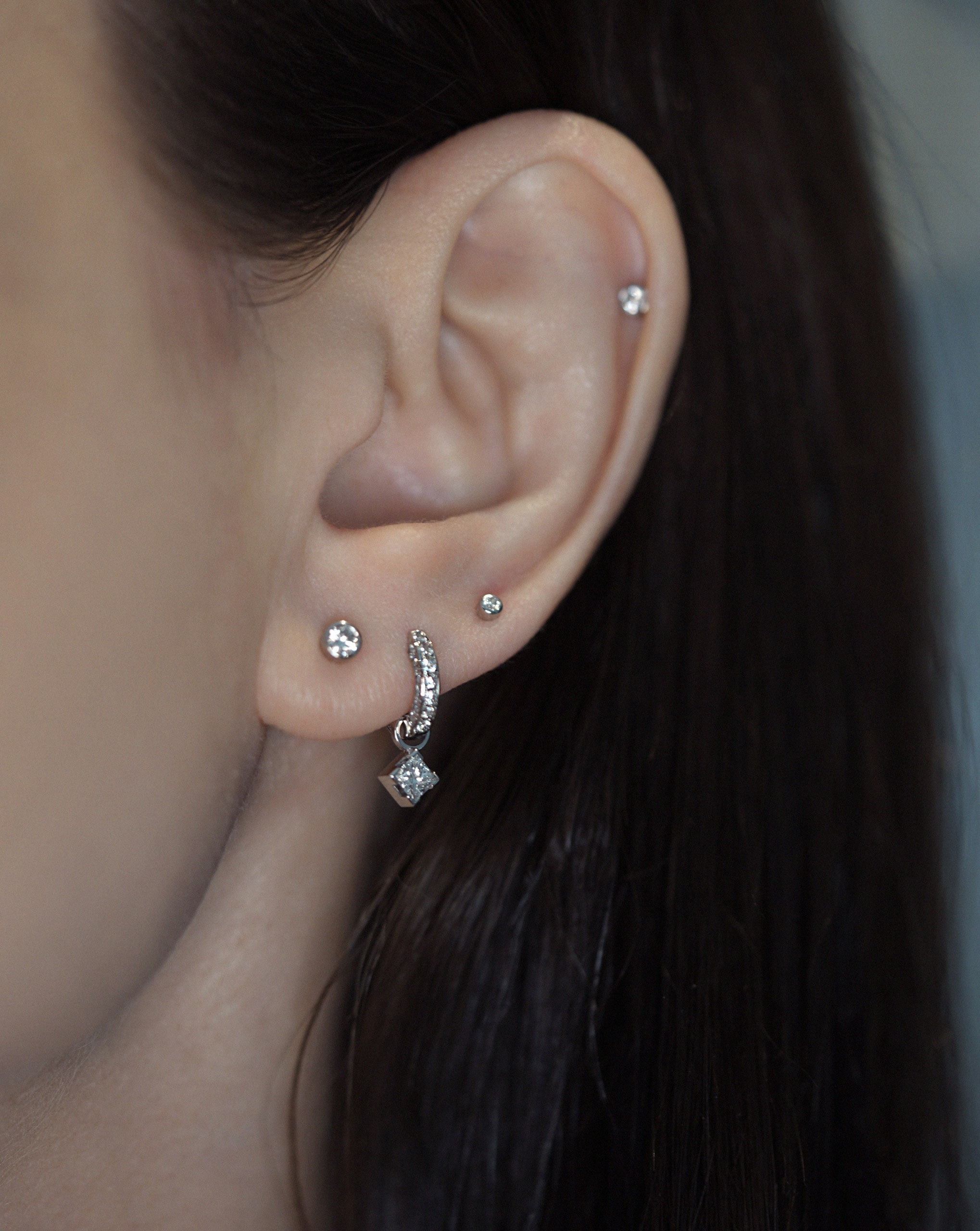
Different stones also ask for different treatment. A square princess-cut diamond has different corners and visual proportions from a round brilliant. A marquise has pointed ends. A small natural gemstone may need a setting that shows colour without making the piece appear unnecessarily bulky.
The useful question is therefore not simply “How large is the stone?” but “How has the jeweller built the piece around it?”


04 · The Part Behind the Ear
The post and backing are part of the jewellery design
Two studs can look almost identical from the front and behave quite differently once worn.
Post length affects how closely the front sits to the ear. Too much excess length can allow a stud to move or tilt. A backing that is disproportionately large may change how the whole piece feels. The connection between post and back also needs to be appropriate for the design.
For the technical differences between screw backs, flat backs and post lengths, see our
guide to secure earring backs and fit.
Look at the Construction
Three different approaches to small fine jewellery
The
Troika Diamond Press-Fit Piercing Stud
shows how several natural diamonds can be grouped into one compact front while keeping the overall piece small.
The
Diamond Medal Piercing Stud
uses a flatter geometric gold front with a natural diamond and allows the bar length to be adjusted to a supplied measurement.
The
Gemstone Martini Flat-Back Stud
takes another route again: a compact natural gemstone setting with a low-profile flat-back construction and made-to-order fit options.
05 · Made to Order
A product page does not always mean one fixed specification
Ready-to-ship, made-to-order and bespoke jewellery are different routes.
A ready-to-ship piece already exists. Made-to-order usually begins with an established design but allows the piece to be produced after the order, sometimes with choices such as gold colour, size, post length, backing or stone option where that design permits.
Bespoke goes further: the brief itself becomes the starting point and the design is developed around the client rather than an existing catalogue piece.

06 · UK Making
UK making matters most when it changes what can actually be done
“British brand”, “designed in Britain” and “made in Britain” do not automatically mean the same thing.
For Lena Cohen Jewellery, pieces are made in the UK through our London workshop and established specialist British jewellery trades where required.
The practical advantage is not simply a country-of-origin label. It is having a making process close enough to the business for questions about stone selection, post length, finishing, remaking, repair or another design adjustment to be discussed rather than disappearing into an anonymous production chain.
Precious-metal pieces are submitted for appropriate UK hallmarking where required by the applicable weight rules.


07 · Direct Jeweller Service
The useful part of personal service is being able to ask a specific question
“Personal service” does not mean much unless it changes the buying process.
For piercing jewellery, useful questions are often highly specific:
Can this stud be made with a shorter post?
Is another backing available?
Can I order one rather than a pair?
Can the diamond be larger or smaller?
Can this be made in white rather than yellow gold?
Can you make another piece to work with it?
The answer will depend on the design, but asking before the piece is made is much more useful than discovering afterwards that a standard specification was not quite right.
08 · When Made to Order Is Not Enough
Piercing jewellery can also be fully bespoke
A catalogue design with a different post length is an adjustment. A new earring developed around a particular diamond, shape, scale, setting and fitting is a different proposition.
Bespoke can make sense when you want a particular natural diamond cut, several coordinated singles, two related but non-identical earrings, a specific scale or a set developed around an existing jewellery wardrobe.
Natural diamonds can be sourced around the brief in round, oval, emerald, radiant, cushion, pear, marquise, princess and other cuts where appropriate. Significant stones can be supplied with relevant documentation.
Fully bespoke Lena Cohen commissions generally begin from £3,000. See the
Bespoke Fine Jewellery service
for the wider commissioning process.


09 · How to Check the Jeweller Behind the Product Page
Look beyond the close-up photograph
A polished product image tells you what the front of an earring looks like. It does not tell you everything about the business responsible for it.
Before buying significant fine jewellery online, check whether the business clearly states the metal, whether diamonds are natural or lab-grown, whether natural gemstones may vary, who makes the jewellery, what can be adjusted, how returns work and who you contact if something needs attention later.
For a broader due-diligence checklist, see
Is Lena Cohen Jewellery a Good Brand? What to Know Before You Buy.
External Profiles & Further Reading
Check the business beyond its own website
Lena Cohen Jewellery is listed in the
Crafts Council Directory
as an independent fine-jewellery designer and goldsmith based in London.
A further
Crafts Council Directory guide to finding an independent UK jeweller
looks at the difference between British branding and British making, as well as ready-to-ship, made-to-order and bespoke jewellery.
Lena Cohen also contributes specialist jewellery-buying advice externally. In
English Wedding’s guide to buying an engagement ring online,
the focus is on knowing who the jeweller is, what will be made, which details will be approved and what happens if something changes.
The brand has also appeared in
The Jewellery Editor
in a clearly labelled sponsored / advertorial feature covering Lena Cohen’s 18ct gold jewellery, piercing designs and London making.
10 · Buying Fine Piercing Jewellery
The design is only one part of the decision
Before ordering, look at the front dimensions, gold specification, stone description, post construction, wearable length and backing rather than choosing from the styling photograph alone.
If an existing piece already fits you well, its measurements can provide a useful reference. If a product is almost right but one specification concerns you, ask whether it can be changed before ordering.
And if what you need is not an adjustment but a different piece altogether, that is the point at which made-to-order jewellery becomes a bespoke conversation.
Fine Piercing Jewellery FAQ
Questions worth asking before ordering
What makes piercing jewellery fine jewellery?
Precious materials are only part of it. Stone setting, proportion, finishing, post construction, backing and the relationship between all of those details determine the finished piece.
Does Lena Cohen use solid 18ct gold?
Yes. Lena Cohen fine jewellery is made in solid 18ct gold, with platinum also used for selected made-to-order and bespoke work.
Are Lena Cohen diamonds natural?
Yes. Lena Cohen diamond jewellery uses natural diamonds rather than lab-grown diamonds.
Is Lena Cohen piercing jewellery made in the UK?
Yes. Jewellery is made in the UK through the Lena Cohen London workshop and established specialist British jewellery trades where required. UK hallmarking is applied where required by the relevant precious-metal weight rules.
Can the post length or backing be changed?
On selected designs, yes. Available adjustments depend on the construction, so contact the workshop before ordering if a particular wearable length or backing is important.
Can I order one earring rather than a pair?
Many Lena Cohen piercing studs are available individually, while other designs are sold as pairs. The individual product page confirms the available configuration.
What is the difference between made-to-order and bespoke piercing jewellery?
Made-to-order starts from an existing design, sometimes with agreed options or adjustments. Bespoke begins with an individual brief and develops the design around the client.
Lena Cohen Ear Jewellery
Start with the jewellery — then ask about the details
Browse the current 18ct gold ear collection for studs, flat backs, screw backs, huggies, hoops and other fine ear jewellery. If the design is right but the specification is not, contact us before ordering.
Lena Cohen Jewellery · London
Small jewellery still deserves full-size attention
A fine piercing earring may weigh very little and occupy only a few millimetres of the ear. The quality is still determined by the same things that matter in larger fine jewellery: material, proportion, setting, construction, finishing and who is responsible for the finished piece.
The scale is smaller. The jewellery-making questions are not.