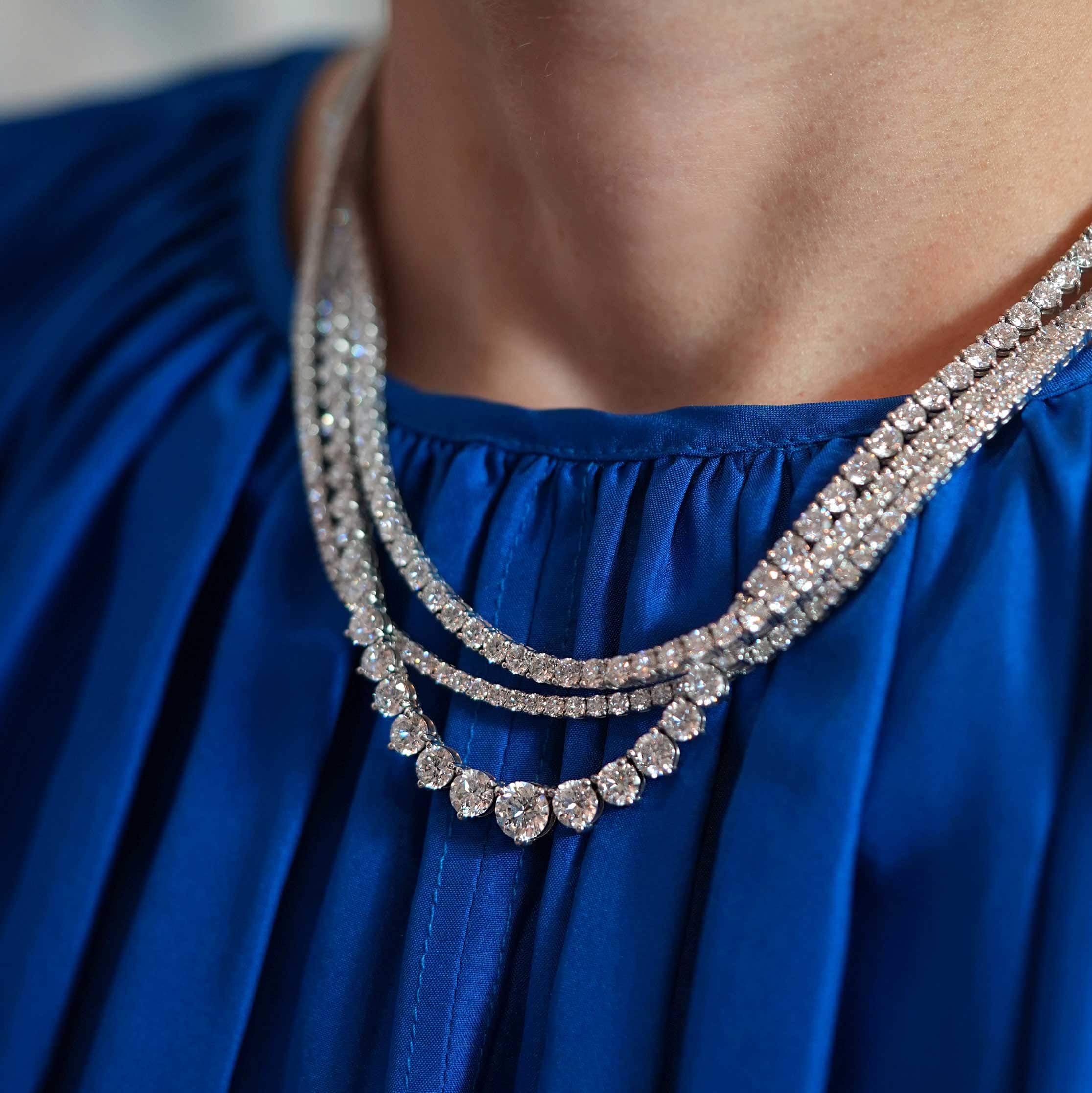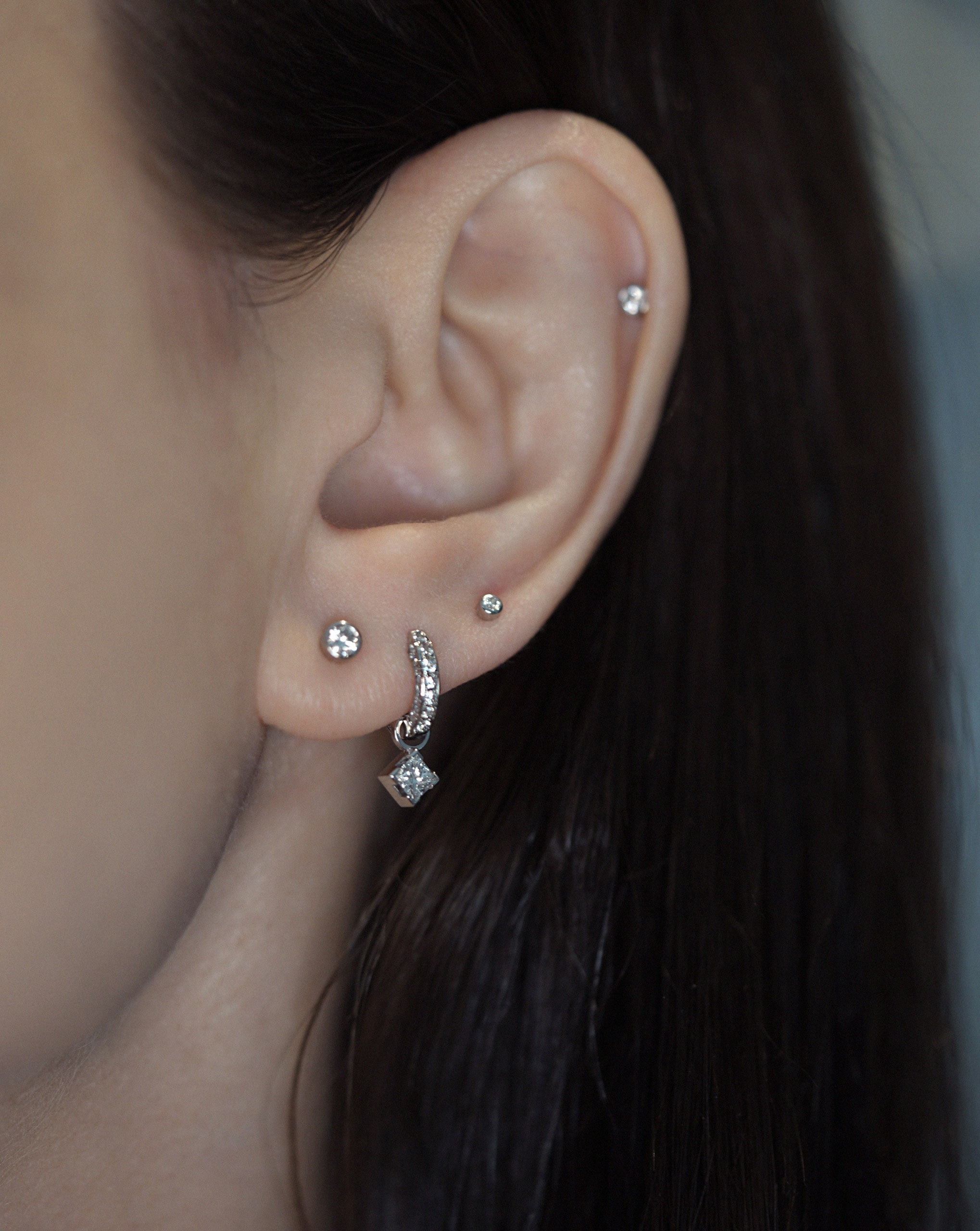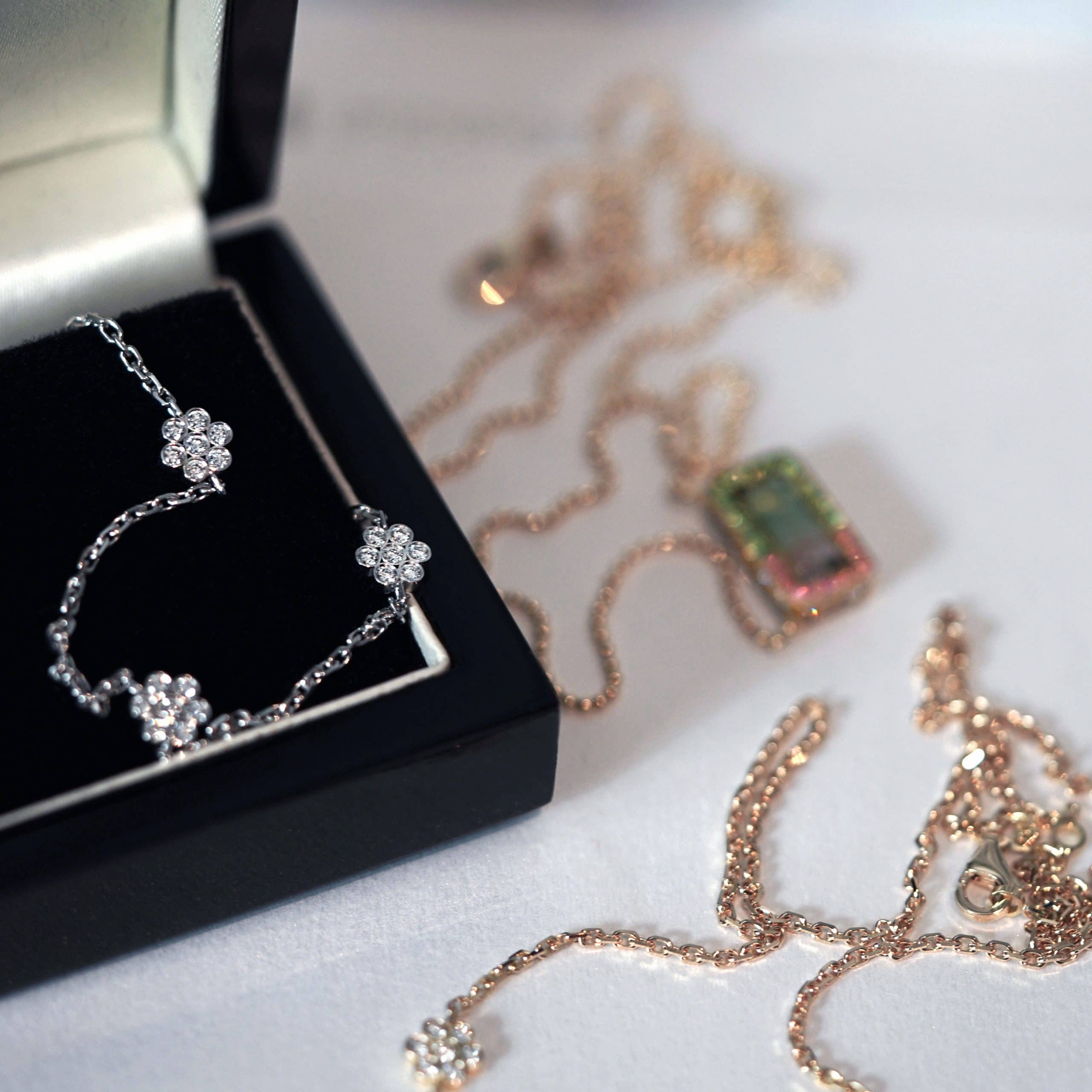
A good curated ear is not simply an ear with more earrings. The strongest combinations usually have hierarchy, contrast and enough space for individual pieces to be seen. Fine jewellery adds another layer: once you are buying solid gold, natural diamonds and pieces intended to stay in your collection, it becomes worth asking not only what looks good together, but what deserves the space on your ear. At Lena Cohen Jewellery, we approach the curated ear as a jewellery collection in miniature — built gradually, around the wearer, rather than copied as a complete set.
Fine jewellery should relate. It does not need to match.
Think of the ear as a composition rather than a matching set. One piece can lead. Another can add a line, a curve or a different surface. A small plain-gold hoop can sit beside a natural diamond without competing with it. A pearl can soften a geometric stack. The aim is not to make every piercing equally important.

Your anatomy should influence the jewellery
One of the most useful ideas associated with Maria Tash and the modern curated-ear movement is that jewellery should respond to the individual ear. Their own styling philosophy describes curation around personal style and ear anatomy rather than treating every ear as an identical template.
That matters even when all your piercings are already healed. A crescent may follow the curve of one helix beautifully and feel crowded on another. A long vertical stud can lengthen a compact arrangement. A small hoop can create separation where another stud would simply add more sparkle to an already busy area.
For a more practical way to judge spacing, scale and visual weight, see our
Curated Ear Ratio Guide.
For the wider anatomy-led approach, you can also explore
Maria Tash’s Curated Ear guide.
Choose an anchor instead of making every earring the star
Current jewellery styling has moved away from simply piling on more pieces. Marie Claire’s recent coverage of jewellery layering makes a useful distinction: start with a standout piece and build contrast around it rather than giving every component the same visual weight.
That principle works particularly well on the ear. An anchor can be a larger first-lobe earring, a distinctive helix shape or a piece with enough diamond presence to establish the composition.
The
Brilliance Line Diamond Stud
uses three natural diamonds in a clean vertical arrangement. Rather than behaving like another small round point, its length creates direction on the ear and can work as the piece that establishes the line for smaller earrings around it.
If you want to see the wider editorial discussion around considered jewellery layering,
Marie Claire’s guide is worth reading.
Lena Cohen ear jewellery includes solid 18ct gold studs, huggies, flat backs, screw backs, pearls, natural gemstones, charms and natural diamond designs for healed piercings. Many pieces are available individually, so there is no requirement to buy a complete matching set.

Use jewellery to change the line of the ear
When several earrings are all small round studs, adding another small round stud rarely changes much. Shape can do more.
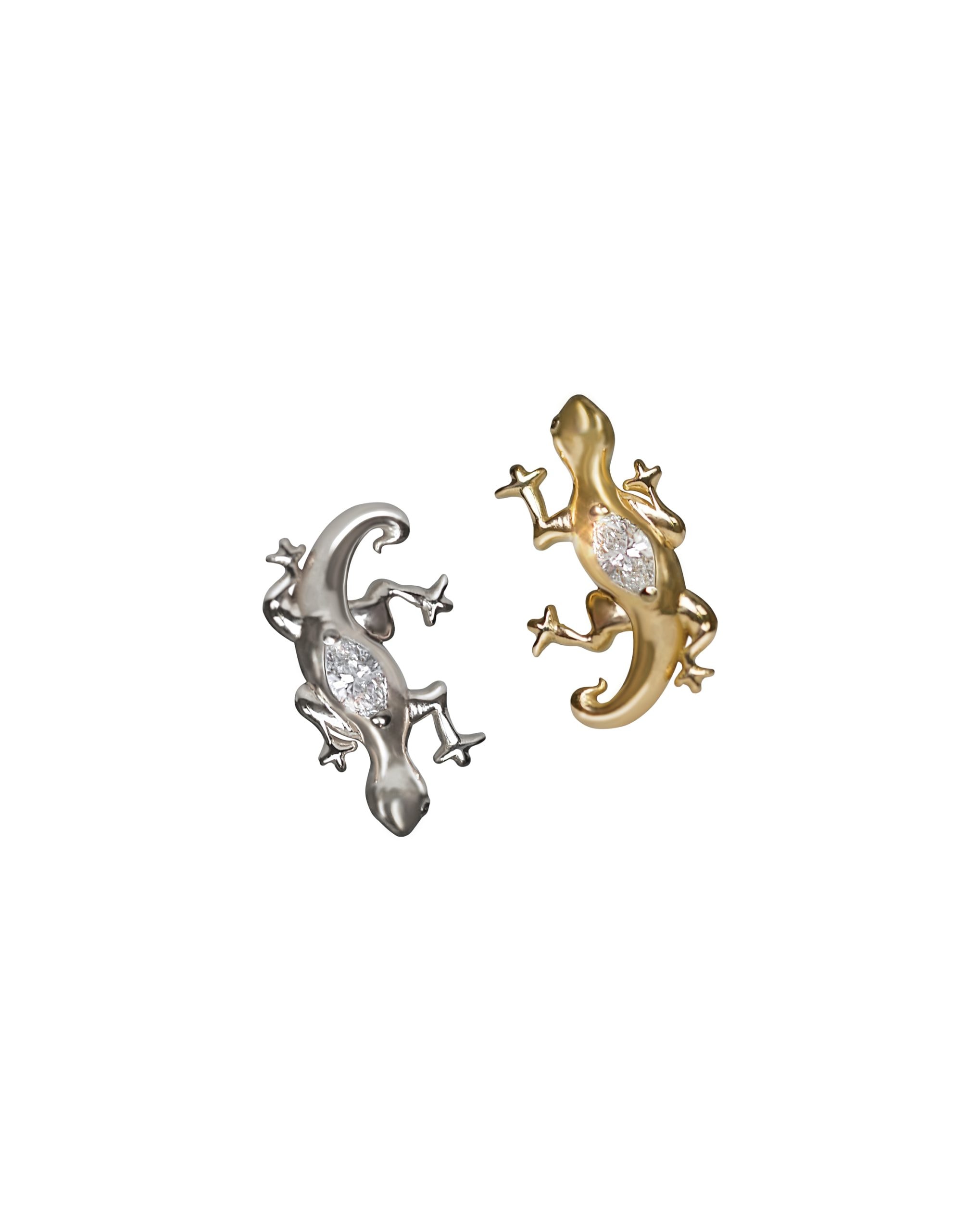
Curves can echo the helix. Vertical designs can lengthen the composition. A figurative or sculptural piece can interrupt an otherwise highly polished diamond stack and stop it feeling generic.
The
Salamander Ear Piercing Stud
is a useful example. It combines solid 18ct gold with a marquise-cut natural diamond, but its real contribution to an ear stack is the curved sculptural silhouette rather than simply adding another diamond point.
A curated ear becomes more interesting when each placement has a job
Traditional jewellery retail was built around matching pairs. A multi-pierced ear does not have to be.
Who What Wear’s long-running curated-ear coverage has consistently mixed studs, hoops, cuffs and longer earrings from different designers rather than treating the ear as a symmetrical matching set. That remains one of the most useful lessons to take from fashion editorial: variety works when the pieces share a visual relationship rather than an identical design.
At Lena Cohen, many ear-jewellery designs are offered as singles as well as pairs. That means a helix can have one characterful earring while the lobe does something completely different, without purchasing a second piece that has no role in the composition.
For broader styling inspiration, see
Who What Wear’s curated-ear edit.
Let the jewellery echo the architecture of the ear
A curved earring placed randomly is simply a curved earring. Placed where the shape follows a natural ridge of the ear, it begins to look intentional.

This is why crescent, garland and climber forms work particularly well in curated-ear jewellery. They can occupy more visual space without necessarily requiring a much larger stone.
The
Diamond Helix Crescent Stud
is designed as a single curved piece in solid 18ct gold and is available with natural diamonds or selected natural gemstones. It can create a clearer sweep along the ear than a row of unrelated small studs.
Not every element needs to sit tightly against the ear
Studs and small hoops create structure, but an entire ear made only from close-fitting pieces can become static. One moving element can change the rhythm of the composition.

The
Matchstick Diamond Chain Threaders
use a fine 18ct gold chain, polished bar and natural diamond to introduce movement below the lobe without needing a large drop earring.
The point is not that every curated ear needs a threader. It is that movement is another design tool — just like diamond size, hoop diameter or stud shape.
Contrast can make the diamonds look better
More diamonds do not automatically create a better ear. If every position has the same brightness and surface, individual pieces begin to disappear into one another.

Pearls are useful because they introduce lustre rather than sparkle. Plain polished gold introduces reflection without stones. Coloured gemstones can create one controlled point of colour.
Our
Pearl Pull Through Earrings
combine Akoya pearls with solid 18ct gold and a fine moving chain. They are deliberately different from another diamond stud or pavé hoop, which is precisely why they can work beside them.
Use hoops to create structure, not necessarily attention
A small polished huggie can act almost like punctuation between stronger pieces. It creates a clean circular form without introducing another motif.

Alternatively, a diamond hoop can become the anchor and allow the surrounding studs to become quieter. The same category of jewellery can play completely different roles depending on scale, stones and placement.
If hoops are the centre of your ear stack, our
guide to styling diamond hoops in a curated ear
goes further into proportion and placement.
A good curated ear should not look like a product catalogue
It is useful to look at several jewellers before deciding what you actually like. Some specialise in very small diamond placements, others in hoops, sculptural gold, pearls or more decorative pieces. Seeing those approaches side by side makes it easier to identify your own preference rather than copying one finished ear.
The same idea comes through in
Lucy Loves Me’s recent helix jewellery guide,
which looks across different jewellery brands and styles rather than presenting one universal formula for the upper ear.
Use outside inspiration to discover possibilities, then come back to your own ear and decide which pieces genuinely deserve a place on it.
Look beyond the styling and ask who actually stands behind the jewellery
A £30 fashion earring and a piece of fine jewellery do not need the same buying process. Once you are spending more, the questions become more important: is the gold solid or plated? Are the diamonds natural or laboratory-grown? Where is the jewellery made? Can somebody answer a question about fit? Can the piece be adjusted, repaired or discussed directly with the business that sold it?

This is one reason independent jewellery businesses can be worth considering. The useful distinction is not simply “small brand versus big brand”; it is whether there is genuine product knowledge, identifiable making, clear materials and accountability behind the sale.
Our guide to
UK independent fine jewellery
explains what to look for when comparing maker-led jewellery businesses, including materials, provenance, production, service and aftercare.
Fine jewellery does not have to become visually polite
There is a tendency to equate more expensive jewellery with safer design: another tiny diamond, another conventional hoop, another perfectly symmetrical pair.
But one of the strengths of an ear stack is that a relatively small area can carry something unexpected without overwhelming the wearer. A sculptural stud, coloured gemstone, pearl or asymmetric detail can give otherwise classic fine jewellery more personality.
The goal is not to make an ear look expensive. It is to make the jewellery look as though it belongs to the person wearing it.
The best ear stack may take years rather than one afternoon
There is no reason to complete a fine-jewellery ear in one purchase. In fact, building slowly often produces a better result.
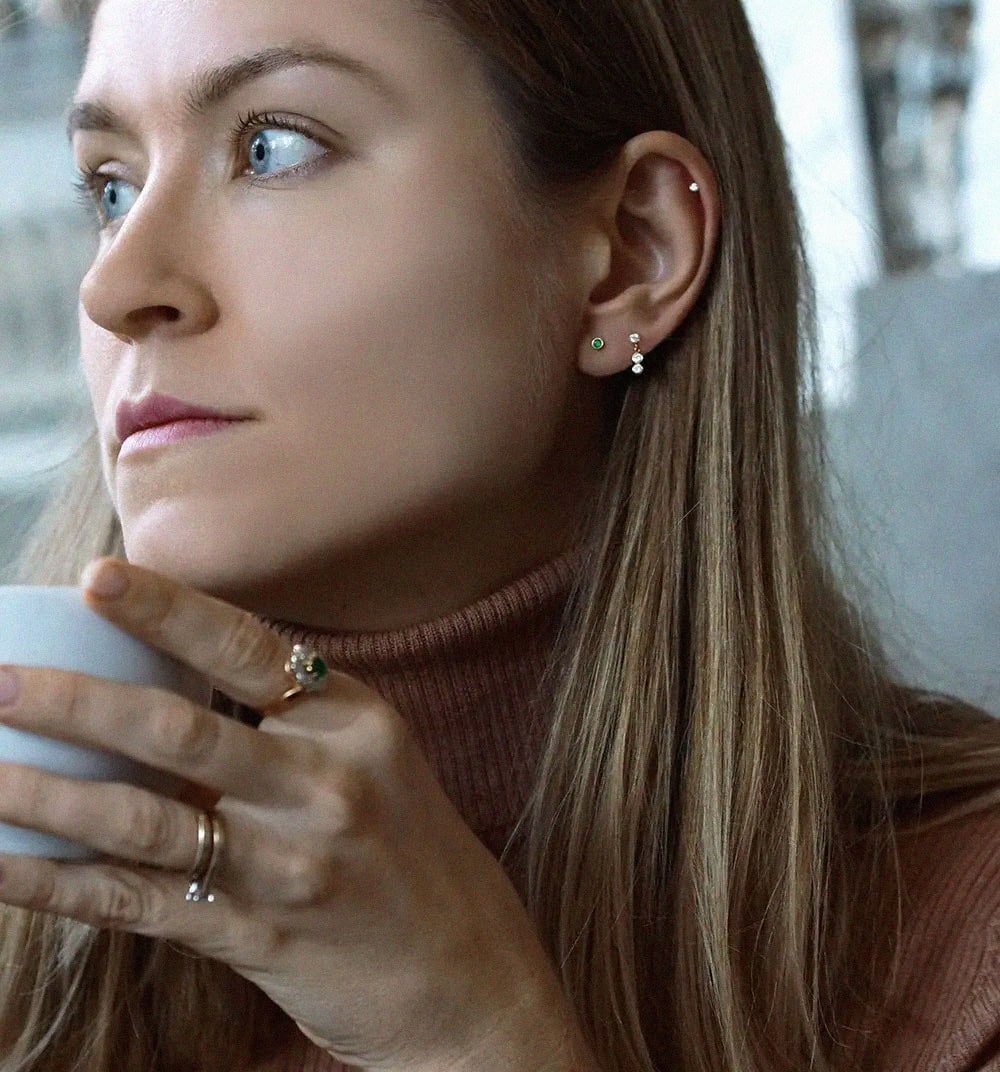
One piece teaches you what you want from the next. Perhaps the diamond stud you thought would be the focal point actually works better as support. Perhaps you discover that pearls suit your skin tone better than expected, or that one small hoop does more for the composition than another stone.
Buy the piece you genuinely want to wear now. Let the next purchase answer a real gap rather than completing an imaginary set.
Give each piece a different job
One Strong Shape
Choose the piece that establishes the direction of the ear: a diamond line, flower, crescent, sculptural stud or substantial hoop.
Something Quieter
Use a smaller diamond, polished gold or simple huggie so the anchor has enough visual space to work.
Change the Surface
Bring in a pearl, natural gemstone, chain or charm when another diamond would add brightness but not enough difference.
Know When to Stop
An empty space can be part of the design. Having another piercing does not mean it needs the loudest possible earring.
A curated ear built as fine jewellery, not disposable accessories
Lena Cohen Jewellery is an independent, family-run London fine jewellery business. Our ear jewellery is made in solid 18ct gold with natural diamonds, pearls and selected natural gemstones, with many designs available as singles as well as pairs.

Pieces are made in the UK through our London workshop and specialist British jewellery trades where required. Rather than outsourcing the customer relationship to a large retail chain, questions about materials, fit, fastening, adjustments and made-to-order work remain with the business responsible for the jewellery.
If that distinction matters to you, read
why clients choose Lena Cohen Jewellery.
Questions worth asking before buying another earring
What makes a curated ear look expensive rather than busy?
Usually restraint. Give one or two pieces visual priority, vary scale and shape, and leave enough space for the individual jewellery to be visible. Price alone cannot create good composition.
Do all the earrings need to be from the same brand?
No. Mixing jewellery can make a curated ear more personal. Look for relationships in gold colour, proportion, shape or stone rather than a matching logo or collection.
Should every piercing have a diamond?
No. Plain polished gold, pearls and coloured gemstones create useful contrast and can make the natural diamonds you do wear more noticeable.
Can I mix studs and hoops?
Yes. In fact, changing silhouette is often what gives an ear stack structure. A hoop creates a circular outline while studs provide smaller fixed points of light or colour.
Should both ears match?
They can, but they do not have to. Repeating one metal, stone or shape across both ears can create a relationship without making them mirror images.
Is a curated ear still a trend?
The styling language continues to change, but wearing several deliberately chosen earrings has moved beyond a short-lived trend. Fine jewellery makes the idea particularly suited to gradual collecting because pieces can be added, removed and restyled over time.
Does Lena Cohen make jewellery for fresh piercings?
Our ear jewellery is designed primarily as fine jewellery for healed piercings. We are a fine jewellery business rather than a piercing studio.
Choose jewellery worth rearranging for years
A fine-jewellery curated ear should be able to change. Wear the hoop alone. Move the diamond higher. Add a pearl. Remove the loudest piece. Buy one new earring rather than an entire replacement set.
Lena Cohen ear jewellery is made in solid 18ct gold in London with natural diamonds, pearls and selected natural gemstones, designed to be collected rather than consumed as a single trend.