Diamond Studs for Older Ears
Diamond studs droop on older ears because the lobe can lose volume, the piercing hole can stretch, and the earring post or backing may no longer support the stud closely enough. The answer is often found in the fit of the whole earring rather than the diamond alone.
For softer, thinner or stretched earlobes, setting profile, post length, total weight and the support behind the ear all influence how a diamond presents. These details become particularly important when choosing a significant natural-diamond pair intended to be worn for many years.
When a stud that once sat correctly begins to lean, first identify what has changed: the lobe, the piercing hole, the weight or height of the setting, the post length, or the backing. These causes need different solutions, and jewellery can improve the fit when the lobe itself is intact.

Why Earrings Droop With Age
Earlobe shape and dimensions can change with age. The lobe may become longer, thinner or less supportive, while years of wearing heavier earrings can gradually enlarge a piercing hole. Either change can make a stud tilt forward instead of sitting upright.
This is why a pair of diamond studs that once looked perfect may begin to sit differently. The diamond itself has stayed the same; the relationship between the lobe, setting, post and backing has changed.

Four Common Reasons Diamond Studs Droop
1. The lobe has become softer or thinner.
A softer lobe gives the earring less structure to sit against, so the diamond can fall forward.
2. The piercing hole has stretched.
If the hole has lengthened, the stud may sit lower or pull down instead of staying centred.
3. The post or barbell is too long.
Extra space behind the ear lets the stud move, tilt or lean away from the lobe.
4. The back gives limited support.
The size and shape of the backing influence how the earring distributes its weight against the lobe.

What Type of Droop Do You Have?
Before choosing new diamond studs, it helps to look at how the current pair is sitting on the ear.
The diamond tips forward: the post may be too long, the setting may sit too high, or the back may allow too much movement.
The stud sits low: the piercing hole may have stretched or elongated over time.
The lobe folds around the earring: the tissue may have less volume and benefit from a closer-fitting setting and considered weight distribution.
The earring feels heavier than it used to: total stone and setting weight may now need to be considered alongside the support behind the lobe.
The piercing is badly torn or almost split: jewellery can improve fit, but damaged tissue should be assessed professionally before purchasing a significant new pair.
How Setting and Post Length Change the Fit
When the lobe is intact, setting profile and post length can make a substantial difference to how closely the diamond sits.
Lena Cohen offers lower-profile martini settings and customised post or barbell lengths on selected diamond studs. The aim is to develop the earring around the way the wearer actually needs it to sit.
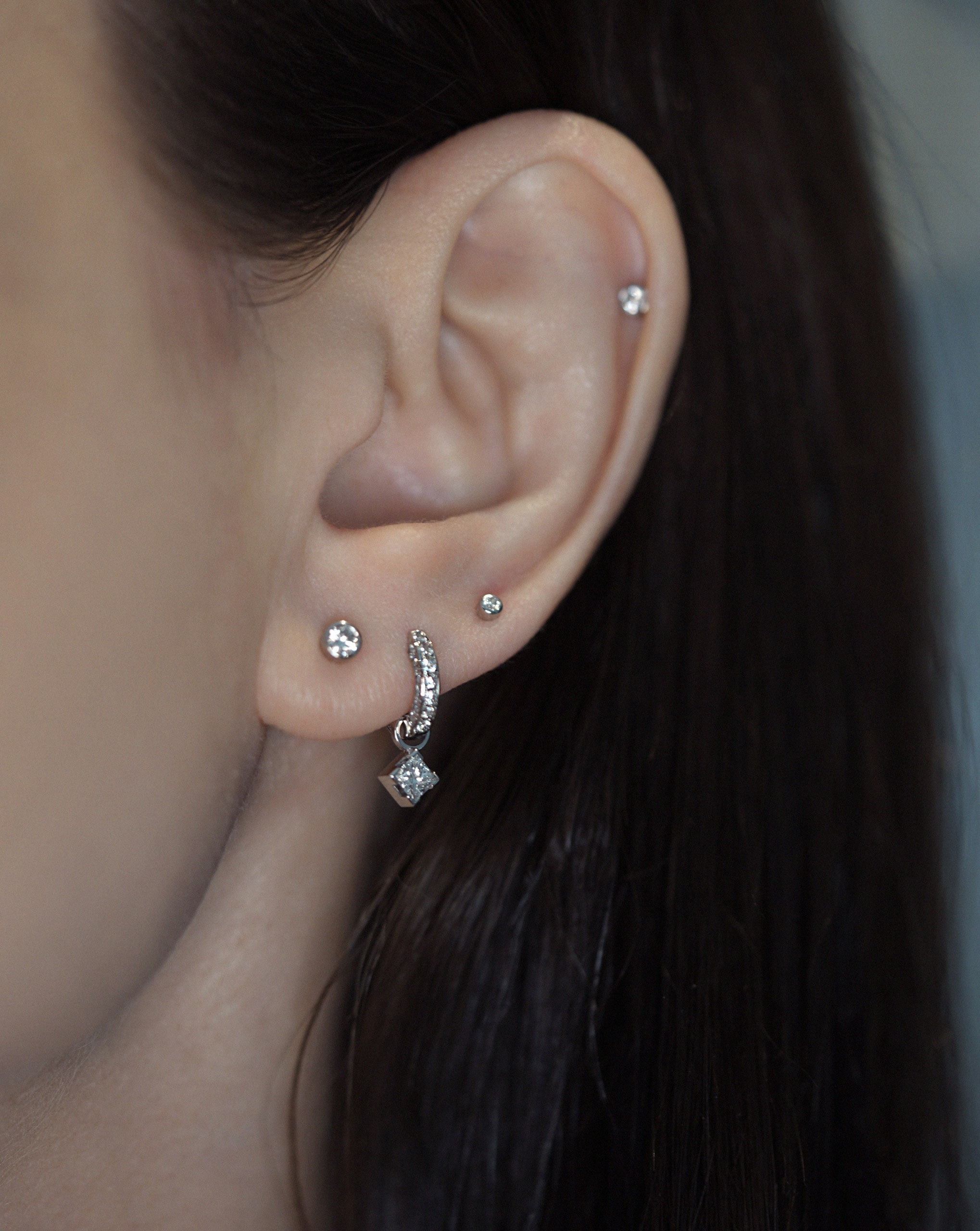
Martini setting: the conical setting lets the diamond sit close to the lobe. On some ears, its lower profile can reduce visible forward tilt.
Customised post length: the wearable length can be adjusted on selected designs so the earring sits closer to the ear rather than moving unnecessarily behind it.

For a Close-Sitting Everyday Diamond
For clients who want a compact natural diamond that sits closely against the ear, the martini setting remains a useful starting point.
| Design | Construction | Useful when |
|---|---|---|
| Solo Diamond Martini Piercing Stud 18K Gold | Natural diamond with threaded screw-back construction. | A classic natural-diamond front with a close-fitting martini profile and secure screw-back option. |
| Martini Diamond Flat-Back Piercing Stud 18K Gold | Natural diamond with low-profile flat back. | A compact back and closer-fitting construction are preferred. |
For a more detailed comparison of screw backs, flat backs and post length, read our
guide to secure diamond-stud backs and fit.

When You Want a Larger Natural Diamond
A mature lobe can still wear a substantial diamond beautifully. The useful approach is to consider the whole earring together: visible diamond spread, setting height, total weight, post length and support behind the ear.

Our
2ct Natural Diamond Stud Earrings
are the classic route for clients who want significant round brilliant diamonds in solid 18ct gold.
The current pair is approximately one carat per ear. For made-to-order or bespoke work, the natural diamonds, metal, setting and fit can be discussed together so the finished pair is developed around the wearer rather than selected by carat weight alone.
When Shape Creates More Presence
Round brilliant diamonds give a familiar concentrated point of light. An elongated diamond changes the proportion across the lobe and can create a broader visible outline.
The
Atelier Cut Elongated Natural Diamond Stud Earrings
were developed for a private client who wanted a clean rectangular silhouette with greater light movement and broad face-up presence.

The original pair uses 2.20ct total natural diamonds in 18ct white gold. New pairs are made to order around the selected natural diamonds and can be commissioned from approximately 0.50ct per ear, with the final carat weight, colour, clarity, proportions, metal and budget agreed before production.
Setting height, post length and backs can also be considered before the pair is made. This makes the Atelier Cut particularly relevant when the client wants a significant diamond earring and a more individual proportion than a conventional round stud.
Made Around the Wearer
A significant pair deserves a considered fitting
For a substantial natural-diamond pair, the diamonds and the fitting can be considered as one commission. Face-up dimensions, setting height, precious metal, post length and backing all contribute to the finished result.
The two ears may also sit slightly differently. Where a bespoke construction allows it, fitting details can be discussed with the individual wearer in mind rather than assuming every pair requires one universal specification.

When the Earrings Should Be Built Around the Ear
Some clients need only a shorter post or another backing. Others are choosing significant natural diamonds and want the entire pair developed around their preferred size, shape and fit.
Lena Cohen bespoke diamond studs can be developed around round, elongated rectangular, emerald, oval, cushion, radiant, pear, marquise, princess and other natural diamond shapes where appropriate.
The brief can include diamond carat weight, colour, clarity, proportions, metal, setting height, post length, backing and the way the earrings should sit on the wearer.
Fully bespoke commissions generally begin from £3,000. For significant natural diamonds, relevant certification and documentation are supplied where appropriate.
Explore bespoke diamond earrings
Working Directly With the Jeweller
Lena Cohen Jewellery is an independent family-run London fine-jewellery business. Made-to-order and bespoke enquiries are handled directly by the small team responsible for the jewellery.
This allows natural diamond options, proportions, settings and fitting details to be discussed before production begins. Jewellery is made in the UK through our London workshop and established specialist British jewellery trades where required.
For a significant pair or a more private commission, see our
Private Client Jewellery service.
A Significant Gift
Choosing diamond studs for your wife or partner
Diamond studs are often bought for an anniversary, birthday or family milestone. You do not need to arrive with a complete diamond specification.
An approximate budget, preferred metal, photographs of jewellery she already wears and a sense of whether she prefers classic round diamonds or something more architectural can be enough for us to narrow the brief to two or three sensible directions.
For a surprise, the diamond and design can be discussed first, with fitting details handled as precisely as the information available allows. For significant commissions, we can also work through a personal assistant, family office or authorised representative.
What to Prioritise in a New Pair
Visible diamond spread. Consider how large the stone looks from the front as well as its carat weight.
Setting profile. A closer setting can help the diamond feel integrated with the lobe rather than projecting away from it.
Post length. A more precise wearable length can reduce unnecessary movement.
Support behind the ear. Backing shape and size contribute to the way the stud sits.
Total proportion. Diamond, setting and fitting should make sense together for the individual lobe.

When the Earlobe Needs Professional Assessment First
Setting, post and backing can improve the way a stud sits when the issue is fit and movement. A badly torn, split or severely elongated piercing needs a different kind of assessment.
If the lobe is damaged, painful, inflamed or changing rapidly, seek advice from a qualified medical professional or experienced professional piercer before purchasing new earrings.
The Diamond and the Fit Belong to the Same Decision
For mature ears, choosing diamond studs is rarely only a question of carat weight. Visible spread, setting height, post length, backing and the character of the lobe all influence how a pair looks when worn.
That applies to a discreet martini stud just as much as it does to a significant round brilliant pair or an individually commissioned Atelier Cut.
For the broader choice of diamond size, shape, quality and setting, read our
complete guide to choosing diamond stud earrings.
Sources & Further Reading
Primary and professional references for the age-related earlobe, stretched-piercing and jewellery-fit guidance used in this article:
PubMed — A morphometric study of the external ear: age- and sex-related differences
FAQ: Diamond Studs for Older Ears
Why do diamond studs droop on older ears?
Earlobe dimensions can change with age and provide less support to an earring. An elongated piercing hole, setting height, post length and backing can also influence whether a stud tilts or sits upright.
Can older women still wear large diamond studs?
Yes. A significant diamond pair can work beautifully when diamond spread, setting profile, total weight, post length and backing are considered together for the individual wearer.
Do martini-set diamond studs help with softer lobes?
They can. A martini setting places the diamond in a compact conical setting, allowing it to sit close to the ear. On some lobes, this lower profile can reduce visible forward tilt.
Can Lena Cohen customise the post length?
Selected made-to-order and bespoke diamond studs can be produced with an adjusted post or barbell length. Available options depend on the individual design.
What is the difference between the round diamond studs and the Atelier Cut?
Round brilliant studs create a classic concentrated point of brilliance. The Atelier Cut has an elongated rectangular outline with a broader face-up presence and a more architectural character. Both can be developed around natural diamonds selected for the client.
Can diamond studs be commissioned as a surprise gift?
Yes. A gift brief can begin with the occasion, budget, preferred metal and photographs of jewellery the recipient already wears. Lena Cohen can then narrow the choice of diamond size, shape and design before fitting details are finalised where required.
Are Lena Cohen diamond studs made with natural diamonds?
Yes. Lena Cohen diamond jewellery uses natural diamonds and solid 18ct gold, with platinum available for selected made-to-order and bespoke commissions.
Can jewellery improve a badly torn earlobe?
Jewellery can improve fit when the issue is setting, movement or post length. Torn, split or severely elongated tissue should be professionally assessed before a new pair is commissioned.
Lena Cohen Jewellery · London
Choosing a significant pair?
You can begin with the diamond shape, approximate budget, metal or simply the way you would like the earrings to look on the wearer. We can then discuss suitable natural diamonds and the fitting details around them.