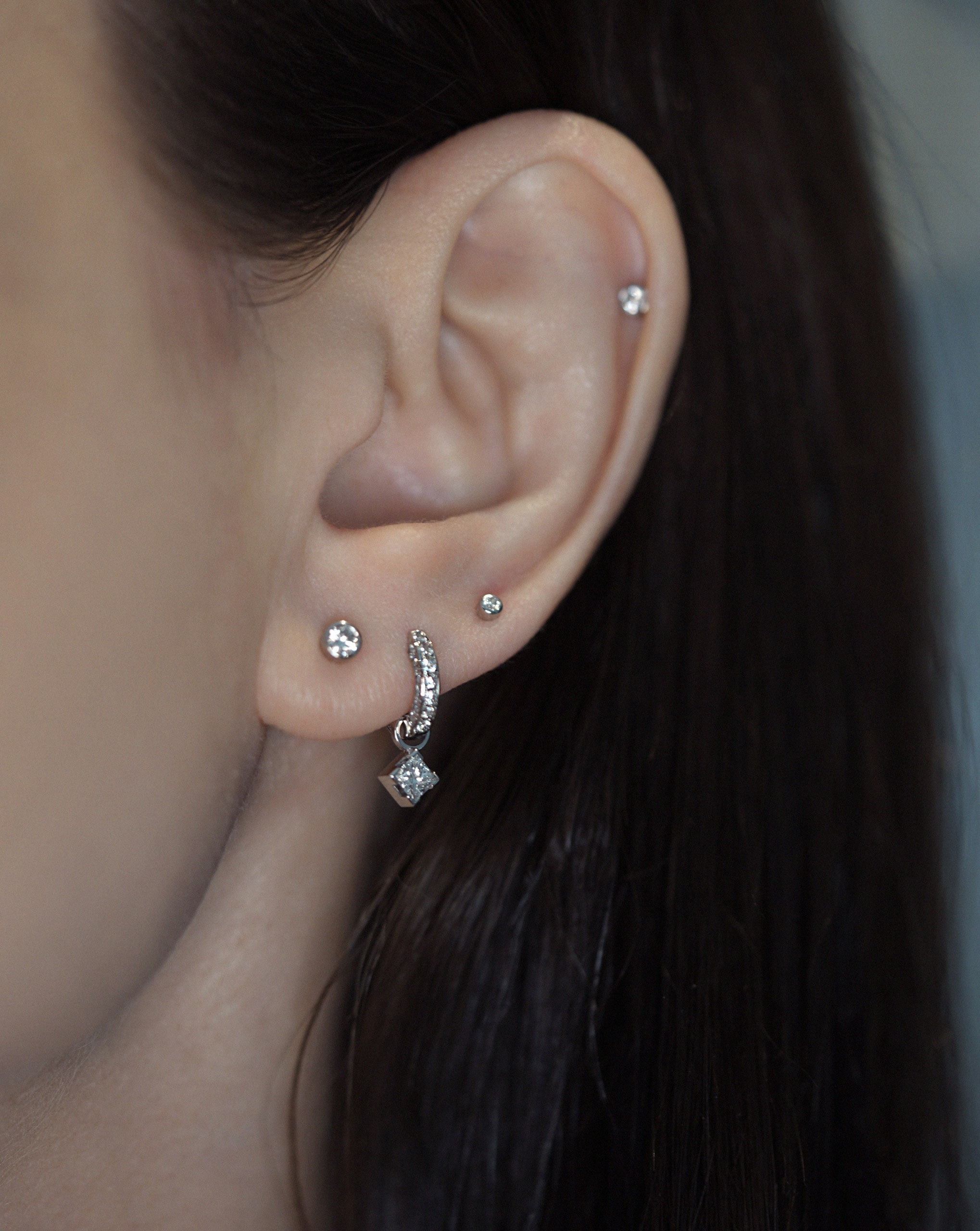
If your diamond studs point downwards, poke behind the ear, feel loose or make you nervous about losing them, the problem may not be the earring itself. The post length, backing, setting height and shape of the ear all affect how a stud sits. At Lena Cohen Jewellery, we make solid 18ct gold earrings in London using screw-back and flat-back systems, and selected designs can be made with a different barbell length. The right fastening should make valuable earrings easier to wear — not something you spend the day checking.
Which earring back is most secure?
For valuable studs, many people prefer a threaded screw back because the back has to be deliberately rotated onto the post. Flat backs are particularly useful when comfort and a low-profile rear surface matter, especially in healed cartilage and upper-lobe piercings. Butterfly backs can work perfectly well for conventional lobe earrings, but security and support depend on the post, the weight of the earring and the individual ear. There is no universal winner: the best back is the one that solves the problem you actually have.

Explore Lena Cohen solid 18ct gold earrings with natural diamonds, screw-back studs, flat-back piercing jewellery and huggie hoops, with many styles available as singles or pairs.
Why do diamond studs point down instead of sitting upright?
People often assume a drooping diamond stud means the stone is too large. Sometimes weight is part of the problem, but it is far from the only explanation.

A long post allows more movement behind the ear. A small backing may provide limited support. A high-profile setting moves the centre of gravity further away from the lobe. Softer or stretched lobes can also change the angle at which the earring sits.

Before downsizing the diamond you actually want, look at the complete construction: setting, post length, back and position on the ear. Our
Diamond Stud Buying Guide
explains how those choices affect the finished earring.
Screw backs are designed for people who want a positive mechanical fastening
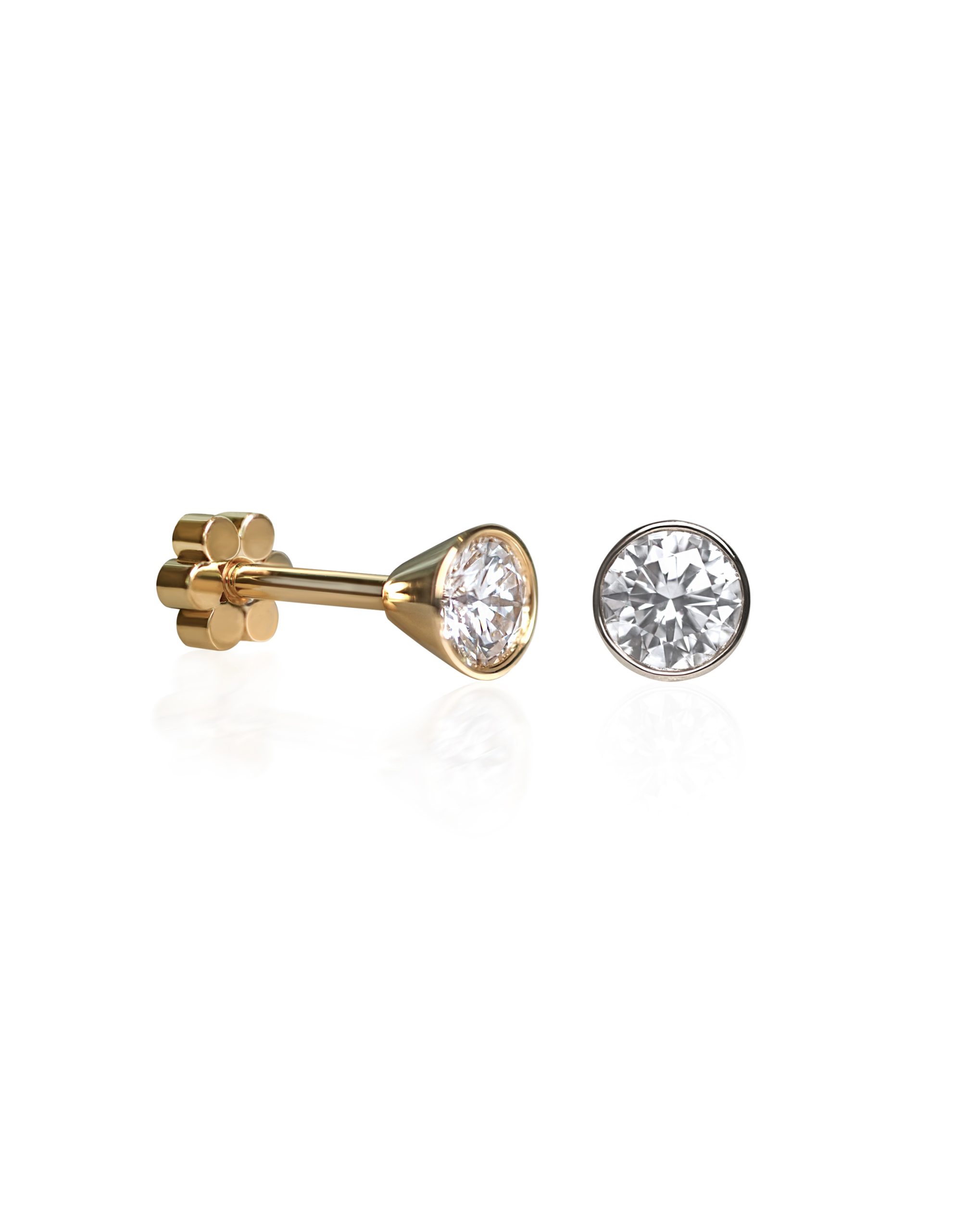
A screw-back earring uses a threaded post and matching threaded back. Instead of pushing the back into position, you turn it along the post.

That makes screw backs particularly appealing for natural diamond studs and other earrings where losing the front would be expensive or upsetting. The back cannot simply slide off in the same way as a conventional friction fastening.
At Lena Cohen Jewellery, several of our piercing studs use a flower-shaped screw back. The shape gives the fingers a practical surface to hold while attaching or removing the earring.

The
Troika Diamond Stud
combines three natural diamonds with solid 18ct gold and a secure screw-back fastening, making it suitable for a refined lobe or appropriate healed cartilage placement.
That is useful information about how you prefer to wear jewellery. Some people are completely comfortable with friction backs; others never stop worrying about them. For an earring you intend to wear often, psychological comfort matters too. A fastening you trust is more likely to result in jewellery you actually use.
Flat backs solve a different problem: bulk behind the ear
A flat-back earring replaces the projecting rear shape of a traditional earring back with a small smooth disc. That can be especially useful when a piercing sits against the side of the head or another part of the ear.

For healed helix, upper-lobe and cartilage piercings, reducing the amount of hardware behind the ear can make the jewellery feel neater around headphones, hair and everyday movement.
Our
Diamond Mini Crescent Flat Back Stud
is made in solid 18ct gold with natural diamonds and uses a press-fit flat-back system for a low-profile finish behind the ear.

Many flat-back earrings use a press-fit system. A fine tension pin on the decorative front is inserted into a hollow post and held by friction. This is different from a screw thread. When correctly fitted, the front and post should feel firmly connected, but the system still needs careful handling because the components are small and precisely made.
If an earring post digs into your head, the post may simply be too long
Changing the back is not always enough. The distance between the front and back of an earring determines how much unused post remains behind the ear.

If the barbell is unnecessarily long, the front can move more than it should and the post may project behind the ear. If it is too short, it can feel tight or pinch.
Several Lena Cohen piercing designs can be made with a different barbell length when you provide the correct measurement. The
Marquise Diamond Piercing Stud
is one example where fit can be considered alongside the natural diamond and setting.
Butterfly backs are not automatically inferior
Traditional butterfly or friction backs remain widely used because they are simple, familiar and quick to put on.
For a conventional lobe earring with an appropriate post and weight, a well-made butterfly back can work perfectly well. The problem starts when one system is treated as suitable for every earring and every ear.
A heavy stud may need more support. A cartilage placement may benefit from less bulk behind the ear. Someone wearing valuable diamond studs every day may simply prefer a threaded fastening.

Headphones, glasses, hair and sleep all change what feels comfortable
The best fastening cannot be chosen from a jewellery photograph alone. Think about what regularly touches the back of your ear.
Over-ear headphones can press against protruding backs. Hair can wrap around posts. A phone may push against a lobe earring. Side sleeping can make long posts uncomfortable. Cartilage jewellery can sit close to glasses or headphone edges.
This is why our ear jewellery is offered with several different fastening systems rather than pretending one back is ideal for every placement.
Screw back, flat back or butterfly?
Choose a screw back when you want a threaded fastening for valuable studs and prefer the reassurance of mechanically attaching the back to the post.
Choose a flat back when a smooth, low-profile rear surface is important, particularly for healed cartilage, helix and upper-lobe placements.
Choose a butterfly back when you want a familiar, quick fastening for a conventional lobe earring and the post length and earring weight suit your ear.
Start with what bothers you most
Screw-Back Diamond Stud
Choose a threaded natural diamond stud where the back is deliberately screwed into place.
Flat-Back Stud
Choose a low-profile back for suitable healed helix, upper-lobe and cartilage placements.
Ask About Bar Length
Selected designs can be made with a different barbell length when the correct measurement is supplied.
No earring back should be ignored forever
Screw threads, press-fit pins and friction backs are small mechanical components. Learn how your particular earring closes and notice if the behaviour changes.
A screw back that suddenly will not tighten normally, a press-fit front that feels unusually loose or a butterfly back that no longer grips the post properly deserves attention before the earring is worn again.
For Lena Cohen pieces, see our
Jewellery Care & Fastening Guide
for practical instructions.
The back of an earring is part of the jewellery
Lena Cohen Jewellery is an independent, family-run London fine jewellery business. We work in solid 18ct gold with natural diamonds, pearls and selected natural gemstones, and many of our ear-jewellery designs are available as singles as well as pairs.
Our jewellery is made in the UK through our London workshop and specialist British jewellery trades where required. That means fit, post length, fastening, adjustment and aftercare can remain part of the same conversation as the jewellery itself.
Read more about
why clients choose Lena Cohen Jewellery
and what distinguishes an
independent UK fine jewellery business.
Bespoke diamond studs can be designed around fit as well as carat
For larger natural diamonds, particular gemstone requests, different proportions, platinum or a fastening requirement that does not fit an existing Lena Cohen design, the earring can be developed as a complete object rather than choosing the front first and accepting the post afterwards.
Our
London bespoke jewellery service
can consider stone, setting, post and fastening together where the commission requires it.
Questions about studs that droop, poke or feel insecure
What are the most secure backs for diamond studs?
Many people prefer threaded screw backs for valuable diamond studs because the back is mechanically attached to the post rather than simply pushed on. Correct fit and condition still matter.
Why do my studs droop?
Possible causes include the weight and profile of the earring, a long post, a small backing or softer or stretched lobes. The whole fit should be assessed before assuming the diamond is too large.
Why does my earring post poke me?
The post may be longer than your ear requires. A shorter correctly fitted barbell or a flat-back system may reduce excess metal behind the ear, depending on the piercing and design.
Are flat backs better for sleeping?
A flat back has less projection behind the ear, which some people find more comfortable. However, fine jewellery can still be subjected to pressure and snagging during sleep, so continuous wear should not automatically be assumed to be ideal for every piece.
Are butterfly backs unsafe?
No. A good butterfly back can be appropriate for conventional lobe earrings. The right fastening depends on the earring weight, post, piercing position and the wearer’s preference.
Can Lena Cohen make a different barbell length?
Selected piercing designs can be made with a different barbell length when the correct measurement is supplied. Check the product page or contact us before ordering.
Can I buy Lena Cohen diamond studs as singles?
Many Lena Cohen piercing and diamond stud designs are available individually as well as in pairs, making them suitable for helix, cartilage, multiple-lobe and asymmetric ear styling.
Do not choose a diamond stud from the front alone
The diamond may be the part everyone sees, but the setting, post, backing and fit determine whether the earring sits properly, feels comfortable and stays in your jewellery rotation.
Explore Lena Cohen solid 18ct gold screw-back and flat-back earrings, or speak to us if you need help with fit, bar length, a larger natural diamond or a bespoke pair.