You do not need to replace every earring you own to turn an ear stack into fine jewellery. Start with the pieces doing the most visual and practical work: the stud you wear constantly, the hoop that anchors the first lobe, or the single earring that gives the whole ear its shape. At Lena Cohen Jewellery, we make solid 18ct gold ear jewellery in London with natural diamonds, pearls and selected gemstones, with many designs available individually so a collection can be upgraded one considered piece at a time.
Which earring should you upgrade first?
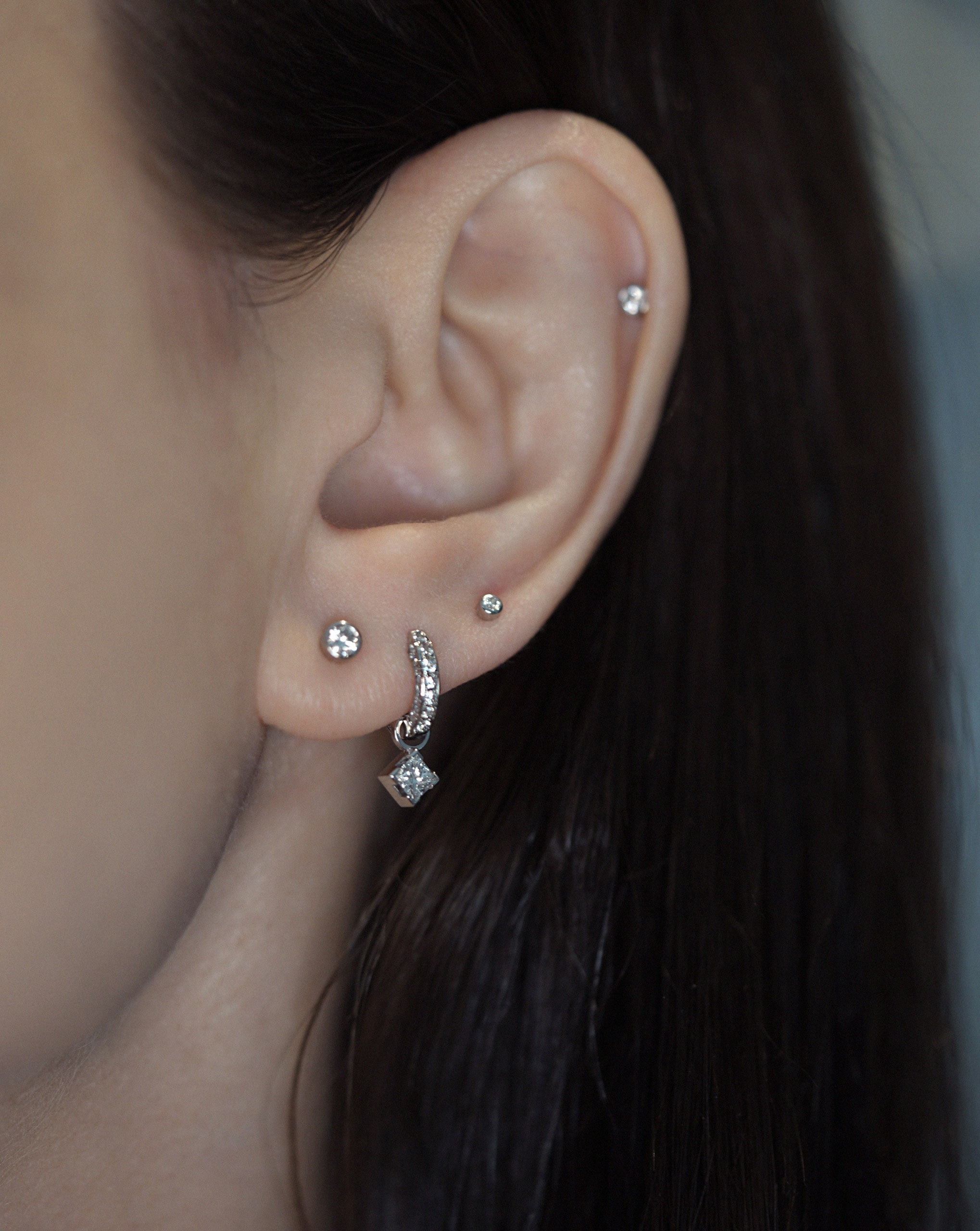
Upgrade the piece you wear most or the one that visually controls the rest of the ear. For many people that means a first-lobe diamond stud or huggie. After that, add one distinctive shape higher on the ear, then improve fit and fastening where necessary. Not every piercing needs a diamond, and you do not need a matching set. The aim is to replace disposable or forgettable pieces with jewellery worth keeping.

Browse Lena Cohen ear jewellery by shape rather than trying to buy a complete look at once. Natural diamond studs, flat backs, huggies, pearl pieces and geometric earrings can be combined gradually around your existing healed piercings.
One strong piece can lift the jewellery around it
The expensive way to improve an ear stack is to decide that every piercing must be replaced at once. The better approach is to identify which piece carries the most visual weight.
Usually that is the first lobe, the largest hoop, the brightest diamond or the most recognisable shape. Upgrade that first. A well-made natural diamond stud beside simpler earrings can immediately make the whole ear feel more intentional.
Fine jewellery does not require every available piercing to prove itself.

A natural diamond stud is the easiest place to begin
A good diamond stud does not need a special outfit. It can sit in a first lobe, second lobe or suitable healed helix placement and work beside plain gold, pearls, hoops or another diamond shape.
The
Solo Diamond Martini Piercing Stud
is made in solid 18ct gold with a natural diamond in a low-profile martini setting. It is available as a single or matching pair, which means you can upgrade one piercing without buying an unnecessary second earring.
Its job is simple: one clean point of natural-diamond light that works with jewellery you already own.

Spend more where the eye lands first. A stronger natural diamond in the main lobe may transform the ear more than four expensive tiny fillers hidden higher up. Fine jewellery is not improved by distributing the budget evenly.
Replace the pieces you wear constantly before the ones you barely notice
If an older plated or fashion earring has become a permanent part of your ear stack, that is a logical candidate for replacement. It has already proved that the position and shape work for you.
Moving to solid 18ct gold changes the object itself rather than simply changing its appearance. Solid gold is an alloy throughout the piece, not a thin decorative layer over another metal.
If you want to understand the difference between solid gold, plating and other jewellery descriptions before spending more, read our
guide to reading fine jewellery claims.

Do not buy a pair when your ear only needs one earring
Traditional jewellery retail assumes symmetry. A modern multi-pierced ear often does not.
If you need one marquise diamond for the second lobe or one shaped piece in the helix, buying two simply because earrings historically came in pairs is not a better use of the budget.
The
Marquise Diamond Stud Earring
is available as a single or pair in several sizes. The elongated natural diamond creates more direction than a round solitaire, so one piece can change the composition of the entire ear.
Buy for the piercing you actually have rather than for a matching set you do not need.

Plain gold and pearls give natural diamonds somewhere to stand out
An ear covered in equally bright diamond pieces can become visually flat because nothing has priority. Fine jewellery needs contrast too.
A plain gold piece or pearl can give the eye somewhere to rest and make the surrounding diamonds look stronger rather than weaker.
For a softer alternative to another diamond, the
Black Pearl Flat Back Stud
combines a natural pearl with solid 18ct gold and is available as a single or pair.

Fine jewellery should fit your ear more intelligently
Moving into fine jewellery is not only about replacing an imitation stone with a natural diamond. It is also an opportunity to stop accepting a post that is unnecessarily long, a fastening you dislike or a piece that never sits quite correctly.
Selected Lena Cohen screw-back designs use a 6 mm barbell as standard and can be made longer or shorter when the correct measurement is supplied. Some designs are also available with flat-back press-fit systems.
If fit is one of the reasons you are upgrading, our
guide to secure earring backs
explains screw backs, flat backs, drooping studs and post length in more detail.
A flat-back stud can be a useful upgrade for a suitable healed helix, cartilage or upper-lobe placement where reducing bulk behind the ear matters.

The
Troika Diamond Flat Back Piercing Stud
uses solid 18ct gold, natural diamonds and a low-profile flat-back system while remaining small enough to work alongside existing jewellery.
Better jewellery will not fix an ear where every piece is competing
An expensive ear stack can still look unresolved if every earring has the same visual weight. One of the easiest improvements is to decide which piece leads and which pieces support it.

Use one stronger diamond, distinctive shape or hoop as the anchor. Allow smaller studs higher on the ear to become quieter. Leave some visual space instead of filling every piercing simply because it exists.
Our
Curated Ear Ratio Guide
looks specifically at scale, spacing and visual balance.
The next purchase should respond to the piece you bought before it
The advantage of building slowly is that each purchase teaches you something. You discover whether you prefer yellow or white gold near your face, whether you reach for round or elongated diamonds, whether a hoop works harder than another stud, and how much visual weight your ear actually needs.
Buy the first good piece. Wear it. Then decide what is genuinely missing.
That is a better route into fine jewellery than buying a complete matching ear simply because someone else styled it that way.
If you are not sure where to spend first
The Everyday Diamond
Start with a low-profile natural diamond stud you can wear repeatedly in the lobe or helix.
A Stronger Shape
Add one piece that changes the line of the ear rather than another identical round stud.
Improve Fit or Contrast
Choose a flat back, pearl, plain gold form or another quieter piece that improves comfort.
Fine ear jewellery without the matching-set mentality
Lena Cohen Jewellery is an independent, family-run London fine jewellery business working in solid 18ct gold with natural diamonds, pearls and selected natural gemstones. Many of our ear-jewellery designs are available as singles as well as pairs because real ear stacks rarely need two identical pieces at every stage.

Our jewellery is made in the UK through our London workshop and specialist British jewellery trades where required. We work in small-scale production and can discuss fit, barbell length, fastening and made-to-order requirements directly rather than treating the earring as a generic accessory.
Read more about
why clients choose Lena Cohen Jewellery
and our approach as an
independent UK fine jewellery brand.
The final upgrade may be a piece made around you
There is no reason to commission bespoke jewellery simply for the sake of calling it bespoke. It becomes useful when the detail you want is specific: a larger natural diamond, an unusual gemstone, another proportion, a particular combination of stones or a fit requirement that an existing design does not solve.

Our
London bespoke fine jewellery service
can develop the piece around both the materials and the way you intend to wear it.
Upgrading an ear stack without buying everything again
Which earring should I upgrade first?
Start with the piece you wear most or the earring that visually anchors the stack. For many people this is a first-lobe stud or huggie rather than a tiny upper-ear filler.
Do all earrings in a fine jewellery ear stack need to be diamonds?
No. Plain 18ct gold, pearls and coloured gemstones can provide useful contrast and prevent every piercing from competing for attention.
Can I buy one fine earring instead of a pair?
Yes. Many Lena Cohen ear-jewellery designs are available as singles as well as pairs, so you can buy for a specific healed lobe, helix or cartilage placement.
Should I replace all plated earrings at once?
Not necessarily. Start with the plated pieces you wear most often or those that occupy the most visually important positions, then upgrade the rest gradually if they continue to earn their place.
Can Lena Cohen change the barbell length?
Selected screw-back designs can be made with a different barbell length when the correct measurement is supplied. Check the individual product information or contact us before ordering.
When is bespoke worth considering?
Bespoke becomes useful when you want a particular natural diamond, gemstone, size, proportion, setting or fit that is not available in an existing design.
Upgrade the piece that matters first
A fine-jewellery ear stack does not have to appear overnight. One good natural diamond stud can replace the earring you wear constantly. A shaped diamond can come later. A flat back or better-fitting barbell may solve a practical problem. Another piece may never need replacing at all.
Build around your own ear, your own jewellery and the pieces you genuinely enjoy wearing. That is a better reason to buy fine jewellery than completing somebody else’s set.